
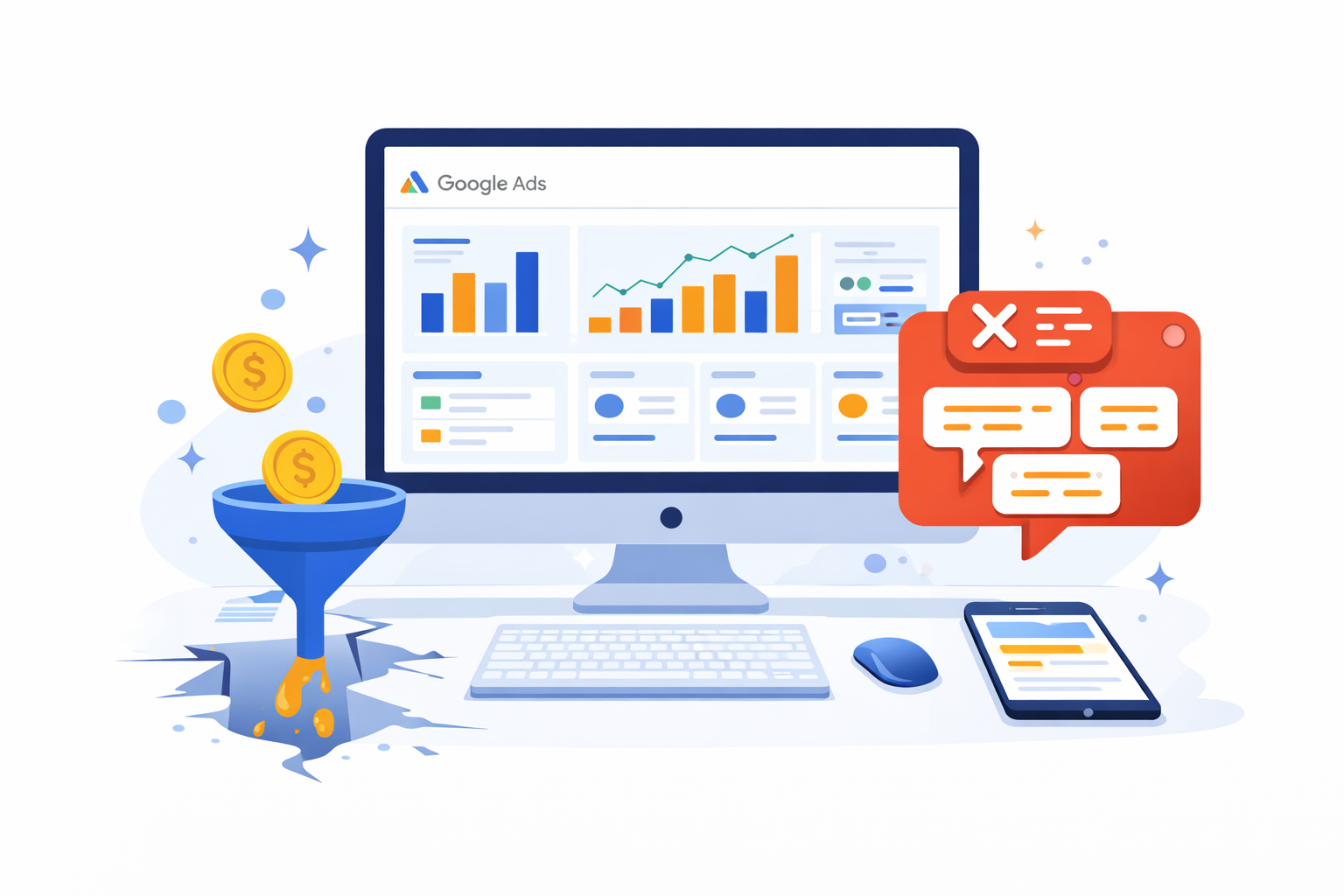
Google Ads is one of the fastest ways to get your business in front of potential customers — but it is also one of the easiest ways to waste money if your campaigns are not set up and managed properly. We have audited hundreds of Google Ads accounts over the years, and the same costly mistakes keep showing up again and again. If your campaigns are eating through budget without delivering the leads or sales you expected, chances are you are making at least one of these 5 mistakes.
1. Targeting Keywords That Are Too Broad
One of the most expensive mistakes in Google Ads is bidding on broad, generic keywords that attract clicks from people who have no intention of buying what you sell. For example, if you are a web designer in Penang bidding on the keyword “design,” you will pay for clicks from people looking for graphic design, interior design, fashion design — none of whom need a website.
The fix is to use more specific, intent-driven keywords that match what your ideal customer is actually searching for. Instead of “design,” target “web design services Penang” or “hire a web designer for my business.” These longer, more specific keywords typically cost less per click and convert at a much higher rate because the searcher already knows what they want. Combine this with proper match types — phrase match and exact match — to prevent your ads from showing for irrelevant searches.
2. Not Using Negative Keywords
Even with well-chosen keywords, your ads can still appear for searches that are completely irrelevant to your business. This is where negative keywords come in — they tell Google which searches you do not want your ads to show for. Without a proper negative keyword list, you are paying for clicks that will never convert.
For example, if you offer professional web design services, you would want to add negative keywords like “free,” “DIY,” “tutorial,” “course,” and “template” to prevent your ads from appearing when people search for those terms. We recommend reviewing your search terms report at least once a week and adding irrelevant queries as negative keywords. Over the life of a campaign, this single practice can save you thousands in wasted ad spend.
3. Sending Traffic to Your Homepage Instead of a Dedicated Landing Page
Your homepage is designed to serve many purposes — it introduces your business, showcases your services, and provides navigation to the rest of your site. But that is exactly why it makes a poor landing page for Google Ads. When someone clicks on an ad for a specific service, they expect to land on a page that speaks directly to what they were searching for — not a general homepage where they have to figure out where to go next.
A dedicated landing page matches the message of your ad, focuses on a single offer or service, and includes a clear call-to-action. This alignment between the ad and the landing page dramatically improves your conversion rate and your Google Ads Quality Score — which in turn lowers your cost per click. Every campaign should have a landing page that is specifically designed to convert the traffic that ad is bringing in.
4. Setting and Forgetting Your Campaigns
Google Ads is not a platform you can set up once and walk away from. Markets change, competitors adjust their strategies, keyword costs fluctuate, and ad fatigue sets in over time. A campaign that performed well three months ago could be hemorrhaging money today if no one is actively monitoring and optimizing it.
Effective Google Ads management requires regular attention: reviewing which keywords are converting and which are draining budget, testing new ad copy variations, adjusting bids based on performance data, pausing underperforming ads, and reallocating budget toward what is working best. We review our clients' campaigns multiple times per week because even small adjustments can have a significant impact on cost per conversion and overall return on investment.
5. Not Tracking Conversions Properly
This is perhaps the most damaging mistake of all — running Google Ads campaigns without proper conversion tracking in place. Without tracking, you have no way of knowing which keywords, ads, or campaigns are actually generating leads, phone calls, or sales. You are essentially flying blind, making decisions based on clicks and impressions rather than actual business results.
Setting up conversion tracking means defining what a “conversion” looks like for your business — whether it is a form submission, a phone call, a purchase, or a chat enquiry — and configuring Google Ads to track when those actions happen. Once conversion tracking is in place, every decision you make can be backed by data: which keywords produce the most leads, which ad copy drives the highest conversion rate, and which campaigns deliver the best return on your investment.
Stop Wasting Your Ad Budget — Start Getting Real Results
Google Ads can be a powerful revenue driver for your business, but only when campaigns are built strategically and managed actively. These 5 mistakes are costing businesses real money every single day — and the longer they go unaddressed, the more budget goes to waste.
If your Google Ads campaigns are not delivering the results you expected — or if you are not sure whether they are performing well — contact us for a campaign audit. We will review your account, identify where your budget is being wasted, and show you exactly how to turn your ad spend into measurable business results.