
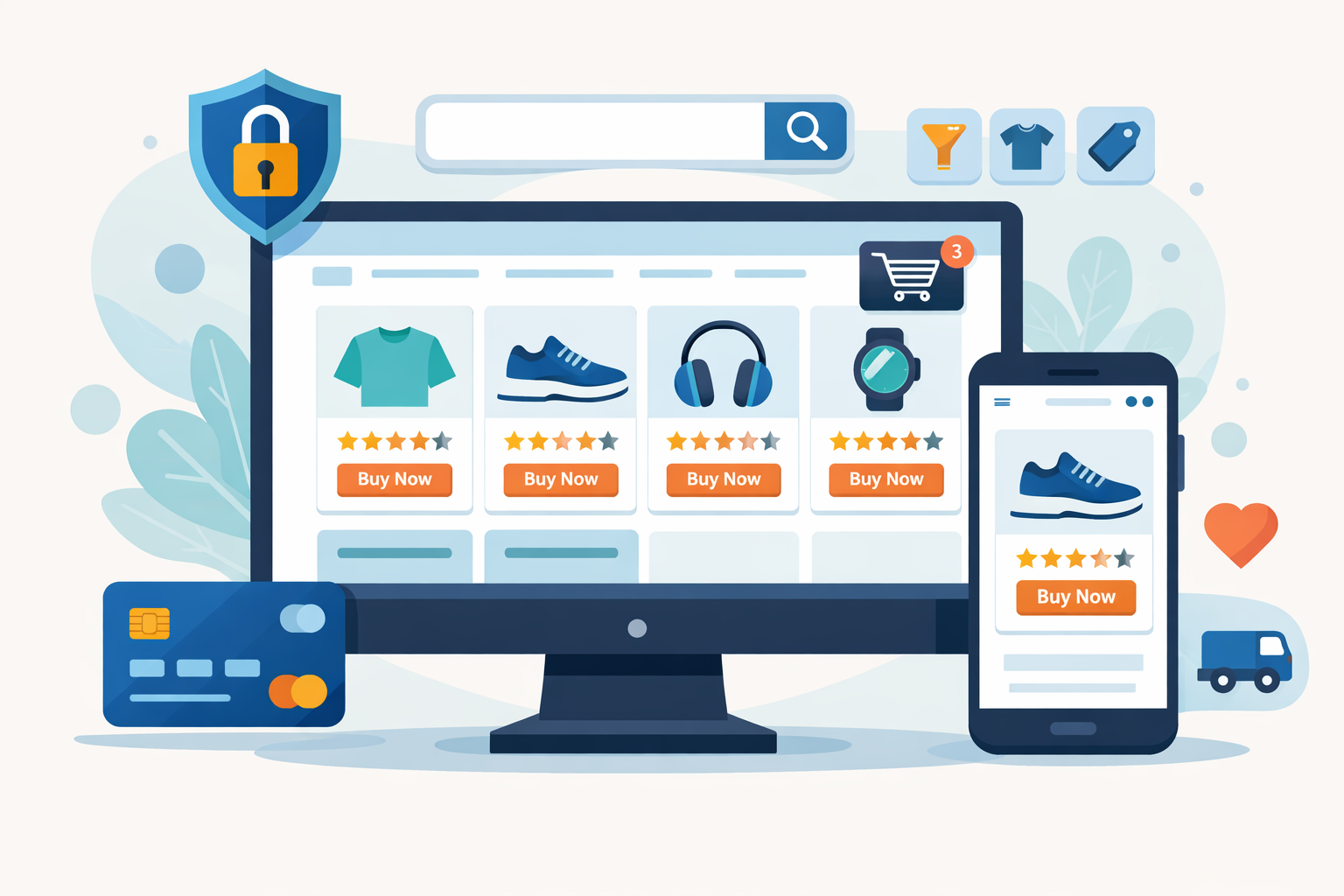
If you run an e-commerce business — or are planning to launch one — the design of your online store directly impacts how much revenue you generate. Leave out key design elements and you will lose orders to competitors who got them right. Include all 7 of the elements below, and you will have a powerful, sales-generating store that converts browsers into repeat customers and steadily grows your bottom line.
1. Professional and Clean Layout
Your e-commerce site needs a professional, uncluttered layout that makes it effortless for visitors to browse and find products. A cluttered design overwhelms visitors, creates confusion, and drives them straight to a competitor. Use whitespace effectively, organize products into clear and logical categories, and keep your navigation intuitive so shoppers always know where they are and how to get where they want to go.
First impressions are everything in online retail. Studies show that visitors decide within seconds whether they trust a website enough to make a purchase. If your store looks unprofessional or disorganized, shoppers will question the quality of your products and the reliability of your business — and they will leave without buying.
2. High-Quality Product Images
Product images are arguably the single most important element on any e-commerce site. Since customers cannot physically see, touch, or try your products before buying, your images have to do the selling for you. Use high-resolution photos taken from multiple angles, include lifestyle shots that show the product in use, and allow users to zoom in to see fine details.
Poor quality images instantly lower the perceived value of your products, regardless of how good they actually are. Investing in professional product photography pays for itself many times over through higher conversion rates. If a customer cannot get a clear picture of what they are buying, they simply will not buy it.
3. Clear and Compelling Product Descriptions
Every product on your e-commerce site needs a description that does more than list technical specifications. Your descriptions should highlight benefits, explain how the product solves a problem or improves the customer's life, and address common questions or concerns. Use bullet points for quick scanning and include practical details such as dimensions, materials, weight, and availability.
Think of product descriptions as your silent sales team. A well-written description does the work of a knowledgeable salesperson — answering objections, building desire, and guiding the customer toward the purchase. Generic or copy-pasted descriptions do none of this, and they hurt your search rankings as well.
4. Trust Signals and Security Badges
Online shoppers are understandably cautious about sharing their payment information with websites they have never purchased from before. Your job is to remove that hesitation by displaying trust signals prominently throughout your site. This includes SSL certificates, recognized secure payment badges, money-back guarantees, return policies, and genuine customer reviews or testimonials.
These trust signals serve as social proof and security reassurance. When a first-time visitor sees that other customers have had positive experiences and that their payment data is protected, the barrier to making that first purchase drops significantly. Place your most important trust signals near your add-to-cart buttons and on the checkout page where buying decisions are made.
5. Easy-to-Use Shopping Cart and Checkout
A complicated or confusing checkout process is one of the biggest reasons for cart abandonment in e-commerce. Customers have already decided to buy — your checkout should make it as simple as possible for them to complete that decision. Keep your shopping cart visible and accessible from every page, minimize the number of steps required to complete a purchase, and always offer a guest checkout option.
Every additional form field, unnecessary page, or confusing step in your checkout process gives the customer another reason to abandon their cart. Streamline the experience ruthlessly: auto-fill where possible, show a clear order summary, offer multiple payment methods, and display shipping costs early — not as a surprise at the final step.
6. Mobile-Responsive Design
With the majority of online shopping now happening on mobile devices, having a mobile-responsive e-commerce site is not a nice-to-have — it is essential to your survival. Your store must look polished and function flawlessly on smartphones and tablets. Buttons should be large enough to tap easily, text should be readable without zooming, images should load quickly, and the entire checkout process must work seamlessly on smaller screens.
A site that is difficult to use on mobile does not just lose that customer in the moment — it loses them permanently. Mobile shoppers have zero patience for pinching and zooming, tiny buttons, or slow-loading pages. If your mobile experience is not as smooth as your desktop experience, you are leaving a significant portion of your revenue on the table.
7. Search Functionality and Product Filtering
Once your product catalog grows beyond a handful of items, robust search and filtering become essential. Customers should be able to find what they are looking for quickly by searching with keywords or filtering by category, price range, size, color, brand, or other relevant attributes. A shopper who cannot find what they want will not browse endlessly — they will simply leave.
Invest in search functionality that handles misspellings, suggests popular products, and returns relevant results. Combine this with intuitive filtering options that narrow results without requiring the customer to start over. Making it easy for customers to find the right product quickly is one of the most effective ways to increase your conversion rate and average order value.
Conclusion
These 7 web design elements are not optional extras — they are the essential building blocks of any successful e-commerce operation. A professional layout, compelling product images, persuasive descriptions, visible trust signals, a streamlined checkout, mobile responsiveness, and smart search functionality all work together to create a shopping experience that converts visitors and keeps them coming back.
If your current e-commerce site is missing any of these elements, every day without them is costing you sales. Get in touch and let me help you build an online store that is designed to sell.